Showing posts with label potatoes. Show all posts

Saturday, November 29, 2014

Betsy Challenge 13: Ethnic Foods

Ethnic foods and their place in the Upper Midwest have always been a fascination for me - in fact, you could probably create a tangled web to show how my interest in ethnic foods led to me creating the Historical Food Fortnightly. Minnesota and Wisconsin are a stereotypical melting pots of European immigrants from all over, pockets of Polish, German, Bohemian, Slavic, and Scandinavian immigrants. These ethnic groups were very distinctive in the mid- to late-19th century, and their foodways contributed to the culinary make-up of the Upper Midwest. This is evident at every church basement potluck or family holiday dinner, with lefse, lutefisk, krumkake, abelskiver and hot potato salads.

In 2010 I attended a conference at Old World Wisconsin. If you haven't ever been, and you live within five hours, I am not being facetious when I say that you must go. It's one of my favorite sites in the Midwest, with over 60 original buildings and acres and acres of gardens, all arranged according to the ethnic groups found in Wisconsin in the 19th century. There is a Norwegian area, a German area, a Polish area, and so on. The interpreters there harvest food straight from these gardens (which have been well-researched and documented) and prepare them according to the ethnic foodways of that area. For historical foodies, it's like Disneyland.

One of the sessions at the conference was, naturally, about foodways, presented by the director of foodways at Old World Wisconsin. I went home with a packet of well-researched and well-documented recipes from their files. I knew that when it came to ethnic foodways, I could trust this treasure trove, and there was one particular recipe I wanted to try out.

The Challenge: Ethnic Foods

The Recipe: Creamed bratwurst, from the recipe files at Old World Wisconsin

The Date/Year and Region: mid- to late-19th century. The recipe itself is Pomeranian (northern Germany/Poland, pre-unification), documented to Wisconsin.

How Did You Make It: It was a very simple recipe: brown sliced bratwurst in a pan, then add cream. Cook together until the bratwurst is cooked through. I used locally butchered, uncooked bratwurst (this is Minnesota, people - we take our brats serious). I took the liberty of adding some black pepper for seasoning. As recommended by the recipe, I served it with some mashed potatoes.

Time to Complete: Half an hour, max.

Total Cost: About $6.50, and would serve about three.

How Successful Was It?: Delicious! It was like bratwurst's answer to Swedish meatballs - the sausage was flavorful and added to the cream gravy. The cream was a little thin, and in the future I might add a roux to make it a little thicker, but it certainly wasn't bad. With the potatoes, it was delicious, even if it doesn't necessarily look appetizing.

How Accurate Was It?: As always, I used an electric stove, and I did not use heritage ingredients. I don't usually rely on others' research for my recipes, but I feel very confident using the recipes from Old World Wisconsin.

Pictures!


Thursday, October 2, 2014

Betsy - Challenge 9: The Frugal Housewife

When I think of frugality, I (of course) think of saving money. However, a couple other principles come to mind: being able to create a tasty and attractive dish, being able to do it cheaply, and being able to utilize any ingredients on hand. My mom is a very frugal housewife in all these respects - her grandmother (my great-grandmother) once told her, "A good cook is someone who can take any ingredients she has on hand and make a meal." She's lived that principle through raising four kids, and now that I am on my own, I try to embody that principle in my cooking.

So I decided to try for a dish that used just a few ingredients one might have readily on hand, would make a dish that could be served proudly at any dinner table, and could be made inexpensively.

I turned to one of my favorite quirky cookbooks from any era, What Shall We Have For Dinner by Lady Maria Clutterbuck*. The book is a collection of bills of fare from the Lady Maria, whose late husband was of a strong appetite that required varying menus. These menus vary from the plainest tables to the fanciest dinner parties. No matter the occasion, Lady Maria has a bill of fare with a wide variety of dishes to suit.

At the end, she includes an appendix of recipes, and one of them is "Potato Balls":

Mmmm. Grated tongue.
Pretty simple, could easily be made with ingredients around the house, and can be dressed up or down depending on the occasion/diners. It's also a great way to use up leftovers - have some baked potatoes from yesterday's dinner? I think this is a very frugal recipe indeed!

*Lady Maria Clutterbuck is the pseudonym of Catherine Dickens, wife of Charles Dickens. He was very much alive at the time the book was written. She herself was a talented writer, and the book was popular enough to go through several printings.

The Challenge:  The Frugal Housewife

The Recipe: "Potato Balls" from What Shall We Have for Dinner? by Lady Maria Clutterbuck (Catherine Dickens)

The Date/Year and Region: 1852, England

How Did You Make It?: Just like it says! I baked some potatoes, let them cool a bit, and then peeled off the skins. I mashed them (adding some salt and pepper), and formed them into balls about the size of a golf ball. I brushed those with egg yolk - the yolk from the egg I grabbed was kind of thick, so it ended up a little gloppy, and the fact that I did not have a pastry brush on hand didn't help. I popped them in a 450 degree oven for about ten minutes to brown.

Time to Complete: I baked the potatoes for an hour, it took about 20 minutes to cool, peel and mash, then another ten to bake. Obviously most of that time was cook time, rather than prep time.

Total Cost: $2 max. I used four medium-ish potatoes and got a dozen balls.

How Successful Was It?: Not bad! They're a little bit like a rissole, but baked (thus healthier). It reminded me a lot of a twice-baked potato, minus the skins and all the fixings. The egg yolk was definitely too thick, but that's easily remedied next time. They could definitely be dressed up with a sauce, or with a garnish, to make them a little fancier, but they were a nice accompaniment to tonight's soup dinner.

How Accurate Was It?: No heirloom potatoes (just plain old russets) and cooked in an electric oven (as always) but besides that, very accurate.


Friday, July 11, 2014

Betsy - Challenge Three: This Day in History

For the This Day in History challenge, I decided to make an Irish dish to celebrate the anniversary of the Battle of the Boyne, a pivotal moment in Irish history. I am of Irish descent, and I studied abroad in Ireland in college, so to say this was up my alley is a bit of an understatement. This choice caused a couple issues; Irish history is notoriously sketchy up to the late 18th century, as Irish history relied heavily on the oral tradition, so primary source documentation is hard to find; the Battle of the Boyne occured in 1690, before the Gregorian calendar was adopted, meaning that the "date" it happened is a sketchy concept; and Irish history and culture has been heavily mythologized, making it difficult to separate the fact from the corned-beef-and-cabbage-lace-curtain-Irish fiction.

Long story short, I solved these problems with the following decisions:
  • I utilized recipes and resources from the 19th century, as these were actually documentable; they didn't go back to the original date of the event, but there's no rule that says they have to.
  • I picked July 11th; the original battle occurred on July 1st of the Julian calendar, which corresponds to July 11th in the new style.
  • I went with the most traditional dish I could find, relied basically zero on secondary sources, and trusted my instincts as to what I know about Irish culture.
For a dish, I picked colcannon. When I was in Ireland, I ate colcannon several times, but I've never cooked it before. It is a very traditional dish of mashed potatoes and cabbage. Although potatoes were introduced to Ireland before the Battle of the Boyne, they really didn't take off as the staple food we now associate with Irish culture until some years later. But, we've already established I'm working within the 19th century, when potatoes were well-established in Irish foodways.

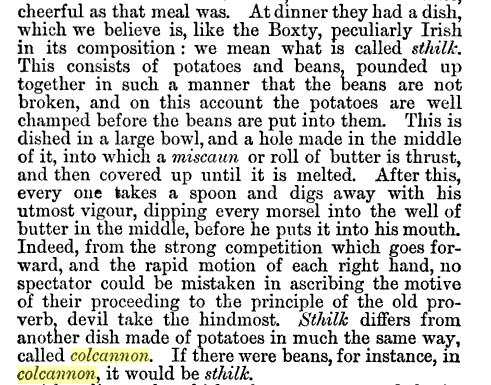
I checked a couple different recipes and sources for info on colcannon. Here's an excerpt from Tubber Derg, a book of Irish stories published in 1869:


I found similar references to how colcannon was eaten in other sources. Later recipes from the 1870s and 1880s have instructions for colcannon that sound like fancy puddings, involving eggs and breadcrumbs and even cheese crusts.

This recipe, from The Cooks Oracle, dated 1825, seems slightly more traditional, though still baked in a mould. Recipes seem to call for spinach, leeks, or cabbage interchangeably.


Also, really plain. Whatever. It's Irish.


The Challenge: This Day In History


The Recipe: Colcannon (No. 108) from The Cook's Oracle


The Date/Year and Region: 1825/England


How Did You Make It: I did exactly what the recipe said. I boiled potatoes (probably about two pounds?) and half a head of cabbage (shredded) separately. I drained off the cabbage and potatoes, put the cabbage in the same pan as the potatoes, and mashed away. I added half a stick (4 T) of butter, plus salt and pepper to taste (probably about a tsp of each, but I didn't measure). I put the whole thing in a casserole dish, scored the top, and popped it in the oven for 10 minutes.


Time to Complete: Hard to say - the potatoes refused to cook quickly, and I was working on several dishes at once. Maybe half an hour?

Total Cost: The potatoes were about $1, the cabbage was $.32, and the butter was negligible. This made about 5 or 6 servings - super, super economical.


How Successful Was It?:  You'd think mashed potatoes with cabbage would be pretty "meh", right? It was actually quite tasty. The Gentleman Friend who taste-tested declared it very good (then again he's not really at liberty to give his honest opinion, but he insisted it was good). I'm going to say that putting in that much butter will make anything taste good.


How Accurate Is It?: Besides the accommodations/creativity listed at the beginning of this, I'd say I did a damn good job of keeping close to the original recipe. I even resisted the urge to add milk to the thing. 


The finished dish, out of the oven.


With the rest of the meal - spring green salad and beef roast. Sorta Irish?