Sunday, October 26, 2014

Wrapping up Challenge 10

Challenge 10 was all about cakes! As always, our participants impressed me with their interpretation of cakes - and the idea of cake has changed throughout history, so there was plenty of scope for the imagination!

First up for some honors is Gail of Art, Beauty, and Well-Ordered Chaos for her chocolate cake from 1877. I love a good chocolate cake (it's no secret I'm a bit of a choco-holic) and this one looks delicious. Well done, Gail!


Next up is Marion, who blogs from across the Atlantic at Green Martha's Kitchen. She made a gonglof (I'm just smiling and nodding here) from a recipe found in La Mode Illustree from 1898. It turned out just so pretty, and I can practically taste it melting in my mouth. Thanks, Marion!


Up Next: Foods Named After People! We're actually halfway through this challenge. This can be food named after someone in particular, like Peach Melba (named after the opera singer Nellie Melba). Or, it could be a food that simply have a moniker attached to it, like a charlotte cake. As always, the sky is the limit!

Friday, October 17, 2014

Betsy Challenge 10: Pumpkin Hoe Cakes

As with every single challenge, I started this one with very good intentions. The challenge was just in time for an immersion event I was doing; making cakes in an 1820s log cabin would be the thing to take my Historical Food Fortnightly participation to the next level!

Well, it didn't happen. I found a cabin-worthy cake, but was so busy having an excellent time (and slumming it as a tavern maid) that I didn't get a chance to make the cakes.

When I got home (after some adventures too tedious to mention here) I decided to make the things I'd been planning on making anyway - pumpkin hoe cakes, from the Kentucky Housewife. Hoe cakes are a kind of fried cornmeal cake indigenous to the southern United States. I picked this recipe because it was simple and fast. It was also dated to the time in which our cabin was first built and occupied, and a similar location (our cabin having come from Tennessee) and it was very appealing to cook the same food that might have been cooked in the cabin when it was first occupied. It was also very seasonal - 'tis the season for pumpkin, after all.


The Challenge: Let Them Eat Cake!

The Recipe: Pumpkin Hoe Cakes, from The Kentucky Housewife by Lettice Bryan

The Date/Region: 1835/Kentucky

How Did You Make It: The recipe calls for 1 quart of cornmeal, and 1 pint of pumpkin. You mix this together, with enough milk to make a thin dough, and fry it on a griddle greased with lard or butter until browned. Serve hot with butter.

I surprisingly know a thing or two about working with cornmeal, and one of the things I know is that corn has no gluten. Cooks in the 19th century often used cornmeal in exactly the same ways as they would use wheat flour, but  corn's lack of gluten makes cornmeal a very different creature.

When working with cornmeal, it is helpful to use hot (boiling) water and let it sit for about 20 minutes before working with it. This gives the best taste and makes the cornmeal more malleable (and less likely to crumble into bits, which was my big concern). So, despite there being no mention of this technique in the original recipe, I heated up the milk to scald it, mixed it in with the cornmeal until it was just moistened, and let it sit a spell.

After it sat, I mixed in the pumpkin. The texture was good, so I dropped it by very heaped tablespoons into the pan to fry. It took about 4 or 5 minutes on each side to fry up, and it was hard to tell when it was browned. A couple did fall apart, but most stuck together - victory!

Time to Complete: About a quarter of an hour from start to finish.

Total Cost: Under $5. I randomly have a superfluity of cornmeal, and a small can of pumpkin was less than $1

How Successful Was It: I was surprised at how much I liked them. They're good in the way that anything browned in butter, and then spread with more butter, is going to be good. They remind me a great deal of fried cornmeal mush (unsurprisingly) or cornmeal fritters. However, they are rather bland. I could see serving them with any mid-19th century condiment - apple butter, fruit preserves, honey, sorghum, molasses, maple syrup, or even spread with brown sugar. I ate them on the side of some carrot soup, which made for a very orange dinner, but they went together surprisingly well.

How Accurate Is It: Besides my liberties with the cornmeal and the milk, I used a can of pumpkin instead of stewing my own heirloom variety, and I am sure the corn is not heirloom either. Modern stove, etc etc etc.


They aren't very photogenic...

Monday, October 6, 2014

Wrapping up #9

Challenge 9 has come and gone! For those keeping track, the Historical Food Fortnightly has 26 challenges (52 weeks in the year means 26 fortnights) so we are just over one-third of the way to the end point!

Challenge 9 was all about frugality - ways to save money, ingredients, time, effort, and more. As always, I'm impressed by the creativity of our challengers, who came up with some really thoughtful ways of interpreting this challenge. I've also been surprised at just how many people are choosing 20th century recipes, so we're featuring two of them this fortnight!

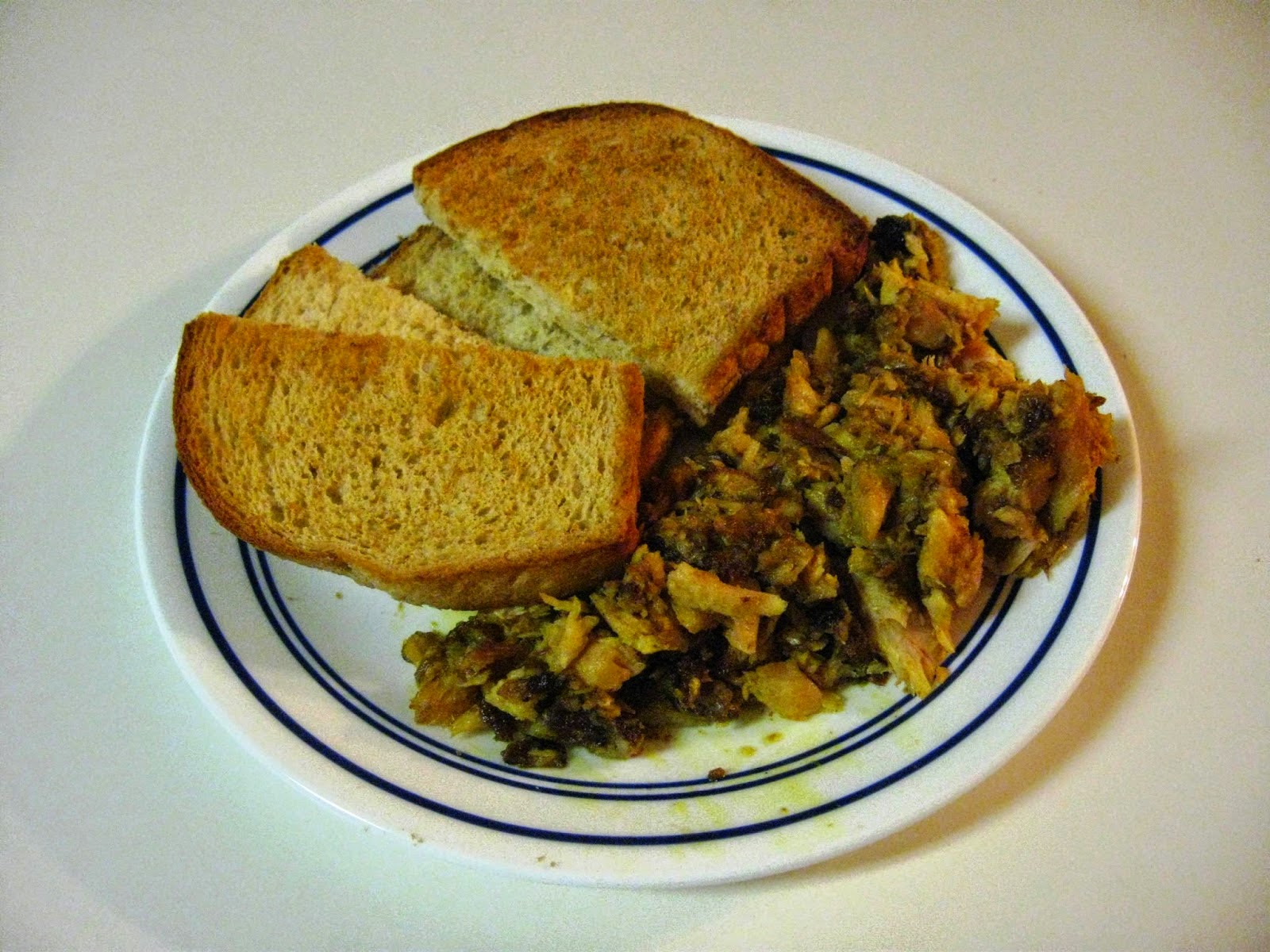
First up is Elizabeth from The Cup That Cheers, with her interpretation of shrimp curry. She substituted trout for shrimp for allergy reasons (staying out of the ER is definitely frugal) and utilized ingredients found in the pantry. Saving time shopping and using what's on hand is definitely a "frugal housewife" move. Well done, Elizabeth!


Next is June of Food History. June is a relative newcomer to the Historical Food Fortnightly. There's no such thing as "too late" around here - we encourage people to jump in and participate as much as they are able, whenever they are able! June's first post about victory bread was a great first post with excellent research. Way to go, June!


Next Up: Let Them Eat Cake. The term "cake" has had different meanings throughout history, so as long as it's called a cake, it's free game. Small cakes, big cakes, fancy cakes, simple cakes, iced cakes, spiced cakes, fluffy cakes, dense cakes - can't wait to see what you all come up with!

Thursday, October 2, 2014

Betsy - Challenge 9: The Frugal Housewife

When I think of frugality, I (of course) think of saving money. However, a couple other principles come to mind: being able to create a tasty and attractive dish, being able to do it cheaply, and being able to utilize any ingredients on hand. My mom is a very frugal housewife in all these respects - her grandmother (my great-grandmother) once told her, "A good cook is someone who can take any ingredients she has on hand and make a meal." She's lived that principle through raising four kids, and now that I am on my own, I try to embody that principle in my cooking.

So I decided to try for a dish that used just a few ingredients one might have readily on hand, would make a dish that could be served proudly at any dinner table, and could be made inexpensively.

I turned to one of my favorite quirky cookbooks from any era, What Shall We Have For Dinner by Lady Maria Clutterbuck*. The book is a collection of bills of fare from the Lady Maria, whose late husband was of a strong appetite that required varying menus. These menus vary from the plainest tables to the fanciest dinner parties. No matter the occasion, Lady Maria has a bill of fare with a wide variety of dishes to suit.

At the end, she includes an appendix of recipes, and one of them is "Potato Balls":

Mmmm. Grated tongue.
Pretty simple, could easily be made with ingredients around the house, and can be dressed up or down depending on the occasion/diners. It's also a great way to use up leftovers - have some baked potatoes from yesterday's dinner? I think this is a very frugal recipe indeed!

*Lady Maria Clutterbuck is the pseudonym of Catherine Dickens, wife of Charles Dickens. He was very much alive at the time the book was written. She herself was a talented writer, and the book was popular enough to go through several printings.

The Challenge:  The Frugal Housewife

The Recipe: "Potato Balls" from What Shall We Have for Dinner? by Lady Maria Clutterbuck (Catherine Dickens)

The Date/Year and Region: 1852, England

How Did You Make It?: Just like it says! I baked some potatoes, let them cool a bit, and then peeled off the skins. I mashed them (adding some salt and pepper), and formed them into balls about the size of a golf ball. I brushed those with egg yolk - the yolk from the egg I grabbed was kind of thick, so it ended up a little gloppy, and the fact that I did not have a pastry brush on hand didn't help. I popped them in a 450 degree oven for about ten minutes to brown.

Time to Complete: I baked the potatoes for an hour, it took about 20 minutes to cool, peel and mash, then another ten to bake. Obviously most of that time was cook time, rather than prep time.

Total Cost: $2 max. I used four medium-ish potatoes and got a dozen balls.

How Successful Was It?: Not bad! They're a little bit like a rissole, but baked (thus healthier). It reminded me a lot of a twice-baked potato, minus the skins and all the fixings. The egg yolk was definitely too thick, but that's easily remedied next time. They could definitely be dressed up with a sauce, or with a garnish, to make them a little fancier, but they were a nice accompaniment to tonight's soup dinner.

How Accurate Was It?: No heirloom potatoes (just plain old russets) and cooked in an electric oven (as always) but besides that, very accurate.


Tuesday, September 23, 2014

Wrapping Up Challenge 7 and 8

So I seem to be on a kick where I do these posts every other challenge. Life (mostly work) is just that crazy lately. I hope to able to get back to a more consistent swing of things soon!

For Challenge 7, we had a lot of folks making innovative, improved foods from history. Apparently that meant a lot of gelatin! Elin at The Sloppy Cook is one of our European participants, and she has such enthusiasm and a great sense of humor; I always love reading her blog entries and seeing her latest creations. She gave us a brief history of gelatin in her quest to recreate a Nougat Pudding from 1911. It's...well, the presentation might not be so hot, but the recipe sounds delicious! Well done, Elin!

Well that's...interesting.


For Challenge 8, our participants made jams, jellies and preserves. Kim of Turnspit & Table (from Australia! We're very international!) made an incredibly pretty orange marmalade. I'm always impressed with Kim's meticulous research, and this challenge is no exception. Seriously, just look at that picture and try not to drool. Way to go, Kim!


Next Up - The Frugal Housewife! Frugality is a trait that was prized across cultures and centuries, especially in the preparation of food. So let's see how frugal you can be! There are lots of different kinds of frugality - frugality in time, frugality in space, frugality in money. Can't wait to see what you all come up with!

Saturday, September 20, 2014

Betsy Challenge 8: East India Pickle

I have never really enjoyed the process of making jams or jellies. There were a couple autumns I went to town on my parents' crab apple tree and made crab apple jelly, but that lost its appeal quickly. So I knew I wasn't going to do a traditional fruit preserve for this challenge, and instead decided something I'd never done before - pickling.

I am generally too anxious for canning, so I knew I wanted to try one of those old pickle recipes that you can keep in the fridge and keep adding to, rather than sealing it up and storing it away. I also wanted a pickle recipe that didn't have to sit for weeks on end - I wanted quick results. And, straight vinegar is not my favorite scent, so I didn't want to have to cook a whole bunch of vinegar either. I know, I have a lot of requirements for pickles.

Enter the recipe for East India Pickle from our old pal Eliza Leslie, in her Directions for Cookery. Normally I would put up a screenshot of the recipe, but it's spread out over a few pages, so I'll just direct you to page 227. No cooking of vinegar? Check! Pickles ready within a month? Check! She even says that you can keep adding to the pickle, though I will caution you that I highly doubt her "go ahead and keep it for two years" directive - I'm going to figure on these being similar to refrigerator pickles with a shelf life of about three months.

The Challenge: In a Jam (or Jelly, or Preserve)

The Recipe: East India Pickle, from Directions for Cookery

The Date, Region: 1844, American (Philadelphia); a similar recipe with the same name exists in the White House Cookbook from the 1880s

How Did You Make It: First I created the vinegar pickle well ahead of time. I used white vinegar, mustard seeds, shallots, garlic, turmeric and ginger. I could not find long pepper besides ordering it online, so I used black peppercorns instead. This time I doubled the recipe, put it all into a gallon jug, and let it sit in a sunny place (the best I can get to "a warm place") for ten days.

Next, I processed the vegetables. I cut up a head of cauliflower, three bell peppers, three medium-sized carrots, a handful of pearl onions, a whole bunch of green beans and two small cucumbers. I threw in a handful of green grapes, because I had them on hand and I was intrigued by the idea. I put them in a brine and set them in a fridge for a week. (Do note that I let the vinegar and the veggies sit longer than Mrs. Leslie directs - life got busy.)

I took the vegetables out, drained them, and rinsed them with more vinegar. I divided them up into jars. For someone who has real difficulty with spatial reasoning, I actually had the perfect amout of vegetables to fit twelve pint jars. I then strained the vinegar over the vegetables. I was honestly surprised by how good it smelled - I'm not a huge fan of turmeric, but I smelled the mustard, garlic and ginger more than anything. I put the covers on, and stuck them in the fridge.

Time to Complete: Ten days for it all to sit. Processing the vegetables probably took an hour (thank you, mandolin slicer), prepping the vinegar took half an hour (mostly peeling/slicing shallots, garlic and ginger). Canning took about half an hour.

Total Cost: 'SPEEEENSIVE. I ended up with 12 pints of pickles, but the cost for all the spices and some of the more expensive ingredients like the pearl onions and the shallots, plus the cost of the jars, really added up.

How Successful Was It? TBD! I'm going to let them sit for a while before I taste test, obviously. They look and smell good, so I have high hopes?

How Accurate Is It? As usual, I did not have access to heirloom varieties. I also used white vinegar, because I like it better than cider vinegar, but cider vinegar may be more accurate and it would be worth trying with other kinds of vinegar to see the tastes. As mentioned, I also had issues finding long peppers.

Pictures!

The vinegar...look at all the mustard seed at the bottom!


Draining the veggies after soaking in brine

Veggies, ready to be vinegarized!

The finished product


Thursday, September 11, 2014

Melissa: Challenge 7: The Best Thing since Sliced Bread

Here I am, the prodigal admin, returning to the blog after skipping a challenge! I apologize for the tardiness of this challenge, but I had to move in to school and start the new semester so the pear dish I was going to make sadly got pushed aside to do, well, school.  But I'm here! Better late than never, right?

To preface this, I am not a salad eater.  I have never been a salad eater.  I am morally opposed to what most people deem "salad", which is basically layers of fat and oil and cheese with some green stuff to make you feel good about yourself.  So I decided for this challenge I would go back to the start of this terrible thing called salad, the 1920's.  I turned to my original cookbook, Woman's Institute Library of Cookery, 1925, for some background.  The book touts that, "there is no more effective nor appetizing way in which to include [fresh fruits and vegetables] in a meal than in the serving of salads.  In addition, salads make a strong appeal to the appetite and at the same time are beneficial so far as the health of the family is concerned."  Yeah, no.  The "salad" I made was definitely not at the top of the healthy totem pole.

What did I make, you ask?

Banana-and-Peanut Salad
with
Fruit-Salad Dressing

Yes. You heard me correctly.  It was insane.

I started off by making the dressing in a double boiler.  It consisted of 1/2 cup pineapple, peach, or pear juice (I chose pineapple), 1/2 cup orange juice, 1/4 cup lemon juice, 1/4 cup sugar, and 2 eggs.  It was briefly whisked together, then put in the double boiler, boiled until it thickened, taken off the flame and whisked a bit, then left to cool before serving.

What do you do when you don't have a double boiler? This!

As that cooled I prepared the "salad".  The recipe calls for cutting the bananas in half lengthwise, rolling them in crushed peanuts, and serving on a lettuce leaf.  If you'd rather have a more appetizing (disgusting) presentation, you could coat the bananas in the dressing before putting the peanuts on.  No thanks!


I ground the peanuts in a vintage nut grinder, as one does, and then put them on a plate.  The peanuts stuck very well to the middle of the banana but fell off of the outside.  Oh well.


See? It's a salad now because it's served on a lettuce leaf!


After the dressing had cooled, I topped my banana with it and tried this weird concoction.  It's... strange.  There are no bad flavors, the combination is just so strange!  I imagined some kind of bananas-and-peanut butter flavor, but the peanuts kind of faded to the background and all I could taste was bland banana and super citrusy dressing.  But I ate salad!

The Challenge: #7: The Best Thing since Sliced Bread


The Recipe: Woman's Institute Library of Cookery (personal collection)


The Date/Year and Region: Pennsylvania, 1925


How Did You Make It: See above :)


Time to Complete: About 30-45 minutes, the dressing took most of the time


Total Cost: I had to buy large bottles of juice for this project, so I would say about $10 outright, but only $3 was used.


How Successful Was It?: Strange... weird... different... unexpected... My father apparently liked it, since he ate two pieces, while my mother and I (more discerning critics) only ate one each.

How Accurate Is It?: Pretty darn! Most of the items I used would have been available in '25, except the bananas might have been smaller.