Wednesday, December 14, 2016

As mid-December approaches, I'm sure some of you are curious about where things are headed with the Historical Food Fortnightly. I've been very missing for most of the year. Life has been exciting - some of it very good, some of it difficult. That has necessarily changed my focus on many things
The Historical Food Fortnightly was born from the germ of an idea in my head. I wanted to learn more about the history of cooking and food for my own purposes of historical reenactment and living history. I figured the best way to learn would be to challenge myself to do it more often. I thought I could blog about it to keep myself more honest/on track. Melissa pointed out that others would probably want to join in that journey. That's how this all started. 
After the first year, I felt like I had achieved what I had set out to do - learn more and become more adept at historical cooking. Over the past year, my focus has shifted back to things for which I have a greater passion - sewing and knitting, researching mid 19th century life and presenting that research. I also now have a fiance, and we're getting ready to merge our households and get married next year.
I have decided, with a great deal of contemplation and difficulty, to not continue the Historical Food Fortnightly in January 2017. I do not know when, if ever, I will pick it back up again. I have enjoyed the past few years of getting to know all of you and exploring historical cooking and foodways together, and I'm grateful for the experiences we've had. Thank you so much for all you have contributed, your willingness to share, your good humor and positivity. You all have made this adventure so much more than I ever thought it could be! I hope you all will continue experimenting and learning - heck, if you need me to throw you a random challenge to spark creativity, just send me a message, I promise I will answer it.
I want to thank Melissa for everything she has done, and for spurring me on to this whole thing, as well as innumerable friends who have provided help and encouragement and inspiration along the way, and (although he's not a HFFer) my fiance, The Gentleman Friend who has supported this project and acted as a very amiable and worthy taste-tester. (He ate the Nun's Toast. That's sacrifice.)
The Facebook group will stay open - I have absolutely no intention of taking it down, but I won't be adding new members. Same with the blog. If there ever comes a time to revisit this and revive it (and it might - I'm not good at letting things go gently into that good night) I will keep you all in the know via these channels.

Friday, January 29, 2016

Updates!

Hey everyone! I have updated the challengers list so that it should be up-to-date as of this evening. We have almost fifty participants! That's CRAZY. It's so much bigger than last year! From this point on, since we're a month in, I'll be updating the challengers infrequently - there's just not enough time in the day, and I have to prioritize.

Someone recently asked me if I keep up with all of the blogs. Yes! I totally do! It's my favorite part of running this group - getting to stalk all of you and see the things you're doing. Trust me that if you are participating, you are totally on my radar and I'm rooting for you. I'll even stop and think about you all intermittently - like, "I wonder if Jeanette figured out the maple sugar thing she was asking about in the Facebook group", or "I sure wish I could read the French blogs as they are written, instead of putting them through Google Translate like a fool," or "Do you think Keiley would send me some of those coconut brownies if I asked really nicely?"

You're all important important to me and I think of you all as you're cooking. Know that I'm cheering all of you on, and I look forward to every challenge that every participant completes!

Stay tuned for some features from the second challenge - culinary vices!

Sunday, January 24, 2016

Kicking Off 2016! (with some reminders)

It's happening, everyone! HFF 2016 is off and running! I'm happy to say that we have over 40 participants, and that's pretty amazing!

The first challenge was all about meat and potatoes, and we had some outstanding recipes! Meat pies and shepherds pies were very popular options. I thought we'd highlight some returning challengers, and some new ones, for this first post.

First up we have Stephanie Ann of The World Turn'd Upside Down, who was one of our challengers last year and contributed many memorable challenges in 2014/2015. She did not disappoint for her first challenge this year: homemade potato chips. YUM. Enough said. Welcome back, Stephanie Ann!


And we have a new challenger: Susan of Nosh and News, who made a beef and potato pie from 1918. She included some great background information from the newspaper where she found the recipe. That kind of context always makes a recipe come alive for me, and that's the kind of thing we're all about around here. Welcome, Susan!


And Now, A Little Housecleaning...

The list of challengers is up-to-date as of January 5th. I haven't had time to update since thing (I've been sick with a sinus infection, there are professional responsibilities, the holidays, blah blah blah). So there are still some challengers that need to be added to the list. I wish I could say it'll be done immediately, but that's just not the case - I have some other things that take priority right now. And I apologize to those who are waiting - you can obviously still participate (there are no rules saying your name has to be up to participate) and I will get you added as I am able, so it'll be like you were always there.

In the meantime, here's a friendly PSA and a sneak peek behind the scenes of running the Historical Food Fortnightly: there's only one way to get your name up on the list of challengers: through the form that's linked on the Challengers page. The form automatically feeds to a spreadsheet that keeps things organized, and that's where I get your name and the web address of your blog to create a link on the Challengers page. Excel rules everything around me. If you post on the Facebook page, if you comment on a post, if you send me an email, it won't get added to the page.

Some people have asked about updating your information (new blog titles, etc). I've added directions for that in the Challengers page.


Back to the Good Stuff!

Next up is Culinary Vices! People have already been posting their delightfully sinful creations, and I'm excited to see the rest of the posts! Keep up the good work!

Sunday, December 13, 2015

A Reminder About Primary Sources

One of the things we do a bit differently over here at the Historical Food Fortnightly is that we all use primary sources for recipes. In case you're new, I'd like to call your attention to this blog post from last year, just before we started the first round of challenges: Primary Sources and Why They Matter.

You may have noticed I'm not a huge fan of rules. I think rules (while important) tend to get in the way of creativity, so we only have a few rules that we think are Really Very Necessary. One of those rules is that participants use primary sources. It's just way more fun and more cool that way!

But Betsy, I can hear you saying, where do I find primary sources?

You're in luck. It's easier these days to find primary sources than it ever was, thanks to the beauty of the Internet. There are databases and collections at your fingertips, ripe for the searching! We've listed a few of them in the FAQs page.

HFFers*: Anyone care to share some of your primary source goldmines?


*In my mind, this is pronounced "heifers". No offense intended.

Thursday, December 10, 2015

We're Getting Closer!

Just three more weeks until 2016! Have you signed up in the Challengers page? We have a healthy number of participants already!

Remember: even if you participated last year, you need to sign up again! And please, don't leave comments or message me privately about participating - the form feeds directly to a spreadsheet which keeps me sane. Excel rules everything around me.

There is more coming this weekend: stay tuned!

Saturday, November 28, 2015

Get Ready....2016 Is Coming!

The challenges are here! We're one step closer to kicking off! Click on the Challenges tab above to find out more about them. 

Here's some stuff having to do with Historical Food Fortnightly, Round 2 (Electric Boogaloo):

  • We polled our members on the Facebook group to find out what their favorite challenges from the last round were, so you'll see some favorites from last year making a repeat run. We hope you enjoy revisiting these ones!
  • There was some discussion about making this year a monthly challenge instead of a fortnightly challenge. We decided to keep it fortnightly, at least for this year. We'd like an opportunity to more fully evaluate how the fortnightly thing goes before we switch formats (if we decide to switch formats). For now, if you'd prefer to cook monthly, try a half-marathon and do every other challenge. You have my full permission to make the challenges work for you and your life.
  • On a personal note, you'll probably see me doing less cooking. I accomplished what I needed to last year - namely, becoming more confident in my historical cooking skills and adding to my 19th century repertoire - and I have some big stuff coming up in the next year that requires my attention. So you'll be seeing me (and Melissa) doing more admin stuff than actual cooking, and that's maybe the way it should be. We'll be cheering everyone on!

If you want to take part, click on the Challengers tab at the top of the blog and follow the link there to fill out the form. We'll keep adding to the list on a rolling basis as people join!

Let's have a great year of exploring historical cooking together! Stay tuned here for more helpful stuff as we get geared up!

Tuesday, November 24, 2015

Welcome Back!

Welcome back, everyone! The new year looms closer, and that means that the next year of Historical Food Fortnightly is upon us! I hope you are getting excited!

We're busy getting everything in place, and will have some announcements for you soon. And I mean that, as in "really soon", not just "maybe a month from now." So stay tuned for the latest updates on challenges, themes, and more!

In the meantime, we're gussying up the blog a bit. How do you like the new format?

Stick around!

Sunday, May 24, 2015

The end!

This is it, guys! We're up against the last challenge! I don't know about you, but starting this last year, I had no idea what May 2015 would look like. I hope you're pleased with your participation, and that you've learned something new over the past year. I know I did! And that's what this has been about, after all - learning things and stretching ourselves.

I was so close to having a marathon - I tripped and fell at the very end, when a bout of the flu seemed to knock everything in my life off the shelves. I'm still very proud of myself for having gotten through twenty weeks of challenges! I hope that, however you were able to participate, you're proud of your accomplishments as well. Since there are no rules, we can all be winners no matter what.

We do have some people who have completed marathons! I'm not going to call people out by name, because I know I will forget someone and feel awful about it, but if you have done a marathon, comment and let us know! And for those amazing people who completed all 26 challenges, I have a small prize - a little badge you can put on your blog or website or Facebook or wherever, to brag about your accomplishment!


And if you didn't hit the marathon this time around, don't worry, because we'll be back for a second round in September! That's right, a whole new year of challenges. For now, rest on your laurels, find something refreshing to sip, and we'll be back with more details soon!

Monday, March 9, 2015

Betsy Challenge 20: Foods Served at Notable Events in History

I finished this challenge on time, I swear! I just didn't get around to documenting it until now. I have been at the Civilian Symposium in Harrisburg (having the time of my life), and before that I was visiting family in Washington DC (and running them ragged with my sightseeing stamina). I am actually sitting in the airport right now, waiting for my flight back to Minnesota as I type this.

I actually made this recipe on February 23rd. The notable event I chose was Lincoln's second inauguration, which occurred on March 4th, 1865 - almost 150 years to the date! Lincoln's first inauguration celebration had been a very small affair. His family went to the Willard Hotel and had a small luncheon, and then retired privately to the White House. His second inauguration, however, was marked with a grand ball and featured a lavish supper table.

One of the things on the supper table was chicken salad, and I thought I'd like to add that to my historical repertoire. Chicken salad was a very common recipe - almost every cookbook I have from the mid-19th century has some sort of recipe for chicken salad - and they are all very similar. In the end, the recipe I chose was from Practical American Cookery and Domestic Economy, from 1860, as it gave the most explicit directions. It also relied on hard-boiled egg yolks in the dressing instead of raw egg yolks, and since I was trying this out on my mother who stipulated no raw eggs, it was handy.

The Challenge: Foods Served at Notable Events in History

The Recipe: Chicken Salad from Practical American Cookery and Domestic Economy

The Date/Year and Region: 1860, United States

How Did You Make It?: Just like it says. No, really! I halved the recipe, and carved the meat off a cold chicken, which I then cut into small pieces.  I mixed it in with celery and set it aside.


To make the dressing, I mashed up the yolks with the seasonings. I mixed it with the oil, bit by bit. The recipe called for sweet oil - I used an olive oil. When they say to add a little bit of oil at a time, they really mean it - I was never able to get a completely smooth texture. Then a little bit of vinegar.


 I tore up some leaf lettuce, added it to the chicken and then tossed it with the dressing. I had read in Godeys from 1861 that chicken salad should be served with rolls, crackers and butter, so we had all of that on hand. For presentation's sake I put it in a pretty ironstone bowl lined with lettuce leaves, and added the rings of egg yolk as garnish. I think it's pretty enough for the White House!


Time To Complete: About 45 minutes, including carving the chicken. I took my time with it and let the dressing sit for a while to let the flavors marry.

Total Cost: About $12, and serves 4 to 6.

How Successful Was It?: It was really good! The seasonings were good, and although the dressing got a little grainy, it wasn't bad. I held back a bit on the mustard - the original recipe calls for A LOT - and I wish I hadn't, because it really could have used that kick, but with the cayenne it had a nice flavor. Mom enjoyed it as well.

How Accurate Is It?: No heirloom ingredients, as usual, but beyond that I followed the recipe to the letter. I even used a wooden spoon when it called for it.


Monday, February 23, 2015

Betsy Challenge 19: Something Borrowed, Something Blue

I knew that blue foods would be tricky even when we were planning the challenges last summer. Blue foods just aren't really plentiful. The obvious one - blueberries - didn't become popular in recipes until well after my chosen time period (1840s-1860s). So I decided to stretch myself into a new era, and I even had a book I was interested in using.

Fannie Farmer is a legendary chef in American cookery. Her recipe book, The Boston Cooking-School Book, completely revolutionized the way cookbooks were written. Prior to its publication, most cookbooks relied on cooks' knowledge of arbitrary measurements. We're familiar with these at the Historical Food Fortnightly - "butter the size of an egg", and so forth. Fannie Farmer's cookbook promoted a scientific approach to cooking and standardized these measurements into the ones we know today - cups, teaspoons, and tablespoons. She also relied on volume rather than weight. Whether or not this was an improvement, and what it did to American cooking, is up for debate (and if you're interested on how the post-Fannie Farmer home economics movement changed women's roles and domesticity, I highly recommend you check out Made From Scratch by Jean Zimmerman). However, it means that the recipe does not require any of the fudging or translating that older recipes do!

I also borrowed my mom's kitchen to make this, yet again.

The Challenge: Something Borrowed, Something Blue

The Recipe: Steamed Blueberry Pudding, from The Boston Cooking-School Book

The Date/Year and Region: 1912 (Revised Edition), Boston

How Did You Make It: I rubbed the butter into the dry ingredients with my fingertips (which is a technique I learned while learning to make soda bread - it's similar to using a pastry cutter or running it through a food processor, but ends up with a lighter finish). Then I added the milk and the blueberries dredged in flour, put it in the steamer, and put that in a stock pot with water to steam for an hour and a half. Took it out, got it out of the mold, and ate it - couldn't have been easier! And my small mold was a perfect size.

Time To Complete: About an hour and 45 minutes

Total Cost: Less than $5

How Successful Was It?: It's pretty tasty! I didn't have time to make the sauce that should have gone with it, but we had whipped cream on it and that was a nice addition. With no sugar added to it, it's a little bland on its own. I was a little concerned about the taste with so much baking powder added to it, but it turned out like a big biscuit with juicy blueberries in it. The family taste-tested it and gave it two thumbs up.

How Accurate Is It?: No heirloom ingredients but otherwise I followed the recipe to the letter.

Have some pictures!


Rubbing the butter into the dry ingredients

Blueberries are surely the prettiest fruit...


Put into the mold for steaming...bon voyage, buddy!

The finished product! It got a little stuck to the pan but it tasted lovely!

Saturday, February 7, 2015

Betsy Challenge 18: Descriptive Foods

This challenge involves a secret. A dark secret.

My grandmother is the best cook I know. Several years ago, she took her collection of recipes and photocopied them to create a cookbook, which was given to my mother, who then made copies and gave them to me and my siblings. The book has a variety of recipes in multiple formats, from handwritten recipe cards to newspaper clippings.

My favorite recipes are those given to her at her wedding shower in 1951. They come from her mother, her aunts, and some neighbors and friends. The best of all of these is a mysterious recipe for Dark Secret, from "Grammy Hamm".

"Tastes much better than it sounds" - Challenge accepted.


Grammy Hamm is my grandmother's grandmother, Emily Spurney Hamm - this would make her my great-great grandmother. Her husband, Phillip Hamm, was an alderman in the city of Milwaukee. There is no date on the recipe in regards to where she acquired it, but it dates at least to 1951. Even though the recipe comes from Grammy Hamm, I think this recipe may have been dictated to my grandmother's Auntie Anna. She contributed many recipes to the collection, and her recipes are always neatly typed and include notes to "Patty" (my grandmother) in the chipper, helpful voice evident in this recipe.

Sarcastic comments, however, come from my grandmother's mother. You see where I get my snark.
Grammy Hamm's Dark Secret has always intrigued my family - why is it called Dark Secret? Is it, in fact, a cake? Does it actually taste better than it sounds? Perfect for The Historical Food Fortnightly, and a visit to my parents' was a good opportunity to bake the cake. So, this challenge features a special guest: Mom!

You may have noticed something about this recipe. There is no flour. Having already been through this recently, I said, "OH HECK NO I am not doing that again." So Mom and I did some research. There are several recipes on the internet for Dark Secret; all of them include flour, none of them are completely similar to the recipe above. As luck would have it, there's a recipe for date loaf in the family collection of recipes, and it called for an equal amount of flour, sugar, dates, and walnuts, with eggs and baking powder. So we decided to give it a shot. It couldn't be worse than the Washington Cake Fiasco.

 The Challenge: Descriptive Foods

The Recipe: Grammy Hamm's Dark Secret

The Date/Year and Region: 1951 (at least), Milwaukee, WI

How Did You Make It?: The recipe was fairly self-explanatory, but there are a few questionable bits. There's no explanation as to how stiff the yolks and whites need to be beaten, or how they're to be mixed in. So we beat the whites stiff, and folded them in, just to be on the safe side. We then put it in the oven for an hour and 15 minutes, as directed. After cooling, we cut it up with whipped cream.

Time To Complete: About 15 minutes to mix it up, and an hour and 15 to bake.

Total Cost: About $10.

How Successful Was It?: So...neither of us is sure whether this is a cake or not. That secret remains a secret . It's surprisingly light - both of us had assumed it would be very dense, but it's actually very fluffy light a very light egg bread with a crispy crust. Unsurprisingly, it has a deep, nutty flavor. The walnuts give it a lot of crunch, and the dates are sweet and caramelized. It is pretty rich, and I could most definitely see serving this like a trifle, cut up with whipped cream and plenty of fruit. I'd like to try it again with less flour, to see how it might change.

How Accurate Is It?: We made no changes to the recipe, and used a modern coil oven and modern tools/equipment that would have been available in 1951.

Pictures!

The ingredients
The beaten egg whites - so pretty!
What it looks like all mixed together


The finished product! Not dark at all.

ADDENDUM 2/9/2015: Mom went over to Grandma's house yesterday and brought her a slice. The taste test proves it - Grandma says it tastes just like the Dark Secret that her Grammy Hamm used to serve. That is kind of amazing, if you think about it - across five generations, we're tied together by the taste of an old-fashioned date-and-walnut loaf.

Monday, January 26, 2015

Wrapping up 14, 15 and 16, and an announcement!

As we leap forward into a new year, we have plenty of folks working on challenges! As mentioned earlier, I've been down with some sinusy crud, so I haven't been quite as productive as I'd like to be, but it's fun to see what everyone else has been working on!

By way of mentioning some of our participants, Elizabeth celebrated the "Sacred or Profane" challenge with Nun's Farts. Yes, Nun's Farts. Go ahead and giggle, I did too. Joyce of A Taste of History took the Revolutionary challenge and taught us all a little bit about the potato in the French revolution! Who would have known? The potato cakes will probably get a try here - I'm in love with anything having to do with potatoes. Isabella subverted the same theme and boiled a potato. I like your style, Isabella.

In a really sweet, poignant post, Stephanie of The World Turn'd Upside Down made cookies from a recipe that survived from prisoners in a concentration camp. I know I wasn't the only one who was moved to misty eyes when I read that post.

So we've had some very silly contributions, some very educational contributions, and some very meaningful contributions, which is what I think sums up the Historical Food Fortnightly - lots of learning, and lots of fun! We've been having such a great time together, that I'm very excited to announce that the Historical Food Fortnightly will continue for another year! Melissa and I will both be leading this crazy train of foodie fun into 2015 and 2016. We'll be featuring new challenges, and possibly further surprises!

Thanks for all the fun, and we can't wait to keep the party going with all of you!

Saturday, January 24, 2015

Betsy Challenge 17: Revolutionary Foods

I've been a bit absent lately, due to being under the weather. That all culminated in a diagnosis of a sinus infection this week (ew). But, I had plans for the Historical Food Fortnightly, and I was going to follow through on them!

For this fortnight's challenge, I planned on doing Washington Cake, from Elizabeth Hall's Practical American  Cookery. There was no explanation about the connection between Washington and the cake, but George Washington was the hero of the American Revolution so it hit the challenge nicely. It also called for saleratus, which is the mid-19th century name for potassium bicarbonate, a leavening agent that was new to cooks in the 1850s. It was quickly supplanted by its more effective, less disgusting-tasting cousin, sodium bicarbonate, which we know as baking soda, and I planned to use that as a revolutionary leavener.

Here's the recipe:


If you're like me, you may read it a couple times before realizing something. There's no flour in this cake. Not even a little bit. That should have given me some pause, but I was flying high on recent successes and feeling really confident about following the recipe with a wing a prayer.

Spoiler alert: I failed utterly.

The Challenge: Revolutionary Foods

The Recipe: Washington Cake, from Practical American Cookery and Domestic Economy by Elizabeth M. Hall.

The Date/Year and Region: 1860, United States

How Did You Make It?: First, I followed the directions to the letter (after making a couple small adjustments by cutting the recipe in half and using two eggs instead of three). I beat the eggs until they were very light, added the other ingredients, and wound up with a bowl of goop. It was half congealed butter, half gross liquid. I could tell immediately that it wasn't going to happen.

So I mixed it again. This time, I creamed the sugar and butter together, before adding the liquids, and then folding in the eggs. It was slightly more successful, but still not great, and even before adding the baking soda I was dubious. Still and all, I thought I'd give it a go. I put some of the goop into muffin tins and put it in the oven.

After ten minutes, I had bubbling goup that wasn't getting cooked anywhere fast. It reminded me a great deal of the German puffs - buttery eggy grossness. I didn't even take any pictures. It wasn't worth the effort.

Time To Complete: Half an hour

Total Cost: Too much, for failure. The eggs and butter both weren't super cheap.

How Successful Was It?: Ha. Hahahaha. Hahahahahahahahahahaha.

Seriously though, this may indeed be a case of no one having ever tested the recipe. Somewhere out there, there may be some errata from Elizabeth Hall saying "Whoops, there should be some flour in there." With flour, it's very close to a sponge cake - so it may be worth messing with.

How Accurate Is It?: Modern ingredients, modern stove, modern tools (include an electric mixer for beating the eggs), and I switched out the postassium bicarbonate for sodium bicarbonate.

For all that it failed, I'm still pleased. I've learned so much from doing these challenges, and become so much braver and more willing to try new things - it's just another learning moment!


Saturday, January 10, 2015

Betsy Challenge 16: A New Year's Plum Pudding

When I pondered celebratory foods, and thought of this time of year, one thing came to mind: plum pudding. Plum pudding is the traditional steamed pudding served at Christmastime in England and parts of the United States. Sometime in the mid-19th century the name "Christmas pudding" was applied to them, clearly the result of the fact that they were popular to serve at Christmas time.

I also immediately knew when I would want to serve this. Twice a year I spend a weekend with college friends - we call it "Crafting Weekend", but the amount of crafting that gets done is variable. It's a gathering of 8 girls who are all fun, adventurous, and clever, and they all indulge my love of the 19th century. I knew they would be up for trying this out with me at our get-together the weekend after the new year. And I knew they would let me light it on fire.

But more on that later.

One of the key components in a plum pudding is suet. Real suet is very hard to find in the US and I mentioned this to the Gentleman Friend. Lo and behold, he knew of a meat market where real, actual-factual suet could be found. And then he acquired it for me. Be still, my heart.

The final piece that came together: my parents gave me a pudding mold for Christmas! Any bowl that can withstand the steam bath can be used for steaming the pudding, but having a mold with a lid was really, really handy.

So now, I just had to make it. And light in on fire.

The Challenge: Celebratory Foods

The Recipe: "Plum Pudding" from Every Woman Her Own Housekeeper

The Date/Year and Region: 1796, London.

How Did You Make It?: First, I rendered the suet. It wasn't specified in the recipe, but I wanted better control over the product and was worried about not knowing how much processing had happened at the meat processors. I melted it on low heat on the stove, strained out the solids, poured it into a loaf pan lined with parchment paper, and let it cool. Once it was hard, I cut it into pieces, weighed it, and divided it into half-pounds for storing.

Mmmmm fat.
 When it came time to make the pudding, I shredded the blocks of suet with a sharp knife. It was by far the most time-consuming bit, but it wasn't difficult. Sort of like chopping up frozen butter or cheese.


I made the pudding exactly as described in the recipe - mixed up the flour, eggs fat, fruit and spices with enough milk to make it goopy but not liquid. I then put it in the buttered mold, and placed the mold in a stockpot with enough water to come halfway up the sides of the mold. Then I boiled it forever for five hours. I occasionally monkeyed with the heat or added more water, but otherwise it was hands off. It came out looking and smelling fantastic, moist but completely cooked all the way through, as judged by a knife inserted into the thickest part. So I turned it out onto a plate and it looked awesome.


Then it was time to light it up.

Firing the pudding is a British tradition that was described in A Christmas Carol by Charles Dickens, during the Cratchit family's Christmas dinner:

"Mrs Cratchit left the room alone – too nervous to bear witnesses – to take the pudding up and bring it in... Hallo! A great deal of steam! The pudding was out of the copper which smells like a washing-day. That was the cloth. A smell like an eating-house and a pastrycook's next door to each other, with a laundress's next door to that. That was the pudding. In half a minute Mrs. Cratchit entered – flushed, but smiling proudly – with the pudding, like a speckled cannon-ball, so hard and firm, blazing in half of half-a-quarter of ignited brandy, and bedight with Christmas holly stuck into the top."
To fire the brandy, we heated up some brandy to get it fuming, which makes it easier to ignite. Once the brandy is lit on fire, it is poured over the pudding. It's traditional to have a sprig of holly stuck into the top of the pudding, but I could not find food-safe holly and decided to skip it. The alcohol burns off, and the pudding can then be sliced up and eaten with hard sauce or brandy butter. We used a simple hard sauce recipe provided by a friend's grandmother


Time to Complete: Six hours, not including rendering the suet.

Total Cost: About $6. The biggest expense was the raisins and currants - the suet was pretty cheap.

How Successful Was It?: The firing was pretty fantastic! I owe large debt of gratitude to my friend/our hostess, Jenny, for standing by with a fire extinguisher and allowing us to light things on fire in her house. The pudding itself was really, really good. It had no added sugar, just the sweetness from the dried fruits, and I was impressed with the flavors. It was moist and chewy, and the suet gave it a very silky mouthfeel, more like butter than lard or shortening. In the future, I might adjust the amount of suet - by the time I was done with my little bit, I felt like my mouth was coated. I can definitely understand why this would be a winter treat - it's very decadent and rich!

The reactions from the assembled were mixed. The general consensus was that the pudding itself was good, but that some people were not fond of puddings in general. There were a lot of currants and raisins as well, and for those not fond of raisins/dried fruits, it was a lot.

How Accurate Was It?: Modern stove, non-heritage ingredients, and I added the step of rendering the lard, otherwise I followed the recipe to the letter.

Tuesday, December 23, 2014

Betsy Challenge 15: Sacred or Profane

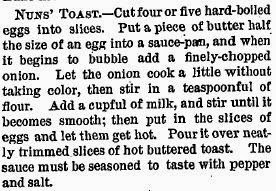
It was sheer luck that caused me to stumble across the recipe for this challenge. I was scratching my head trying to think of any sort of recipe I could do for this, and had nearly settled on devil's food cake, when I stumble across this recipe in A Prairie Kitchen by Rae Katherine Eighmey:


Well that sounded promising! In previous challenges, we discovered the importance of checking one's sources, so I went to the Illinois Digital Newspaper Collection and found the corresponding edition of The Prairie Farmer. There it was!:


The Challenge: Sacred or Profane

The Recipe: Nun's Toast, from The Prairie Farmer

Year/Date and Location: 1883, Midwest

How Did You Make It: Just exactly as directed.The Gentleman Friend helped as I got distracted by a phone call in the midst of it, and then had Issues with the roux.

Time To Complete: Probably half an hour? See aforementioned distraction.

Total Cost: Under $5

How Successful Was It?: Well it's pretty much exactly what you would imagine eggs in a bechamel sauce to be like. I was surprised at how tasty it was! I'm not a huge fan of eggs but I can definitely see the appeal - this is a meal that would stick to your ribs, can be made very cheaply, and would probably be pretty good with some sausage or ham on the side. Gentleman Friend gave it a good review.

How Accurate Is It?: I did not use heirloom ingredients and I cooked it on an electric stove. Beyond that, I followed the directions closely.


Sunday, December 21, 2014

Melissa Challenge 14: Fear Factor

Here I am!  Finally back and posting on the blog!  For those of you who do not know, I am finishing my last year of undergraduate studies, and cooking/baking in my apartment during my busy week is near impossible.  Most of the historic cooking I have been doing has been in the hearth kitchen at Historic Locust Grove, which is amazing and fun and awesome, but I barely have any pictures of that and the recipes I make there don't necessarily line up with what the challenges are.  However, I did realize that I was going to be remaking a recipe I made for the recent Christmastide event, which is definitely feared or revered by most...

Fruitcake!

Specifically, a pound plumb cake from The Housekeeper’s Instructor,  by William Augustus Henderson, 1809


To be honest, I did not hold fast to this recipe.  What I made ended up being an amalgam of a few pound cake recipes I have made.  My tried-and-true recipe follows:

1 pound butter
1 pound sugar
1 pound eggs (about 9 large eggs)
1 whole nutmeg grated, or 1 tbsp ground nutmeg
The zest of 1 lemon
1 gill (4 oz) of brandy or cognac
1 pound flour
1/3 pound currants
1/3 pound candied orange peel
1/3 pound candied lemon peel

Preheat your oven to 350.  Start by creaming your butter and sugar together:

Next, add your eggs.  About 9 large eggs equal one pound, but it's always good to use your handy dandy scale to help measure.


Mix your eggs and butter/sugar until smooth.  Now it's time to add the fun things!  Throw in the nutmeg, brandy, and lemon zest, and mix.  I left out the lemon zest this time because of the inclusion of candied lemon peel.  It's definitely cook's choice.  Also, sometimes you realize that your bowl is too small in the middle of baking.  Introducing great green bowl!


Measure out a pound of flour and mix in.  The batter will stiffen considerably and become more like the cake batter you know and love.


Finish the cake off by stirring in the candied lemon and orange peel and currants.


I find that stirring this in works the best, since the hand mixer can be a little harsh.  I just used a rubber spatula.


Pour the batter into two greased 8-inch cake pans and bake for about an hour, or until a toothpick comes out of the center clean.


Allow to cool on the counter completely, then remove from pans.  If you'd like an extra kick of flavor, I recommend soaking the cakes in brandy for anywhere between a week and a month.  To do this, simply soak a paper towel with brandy and lay them on the cakes within a plastic bag.  Replace the paper towel every couple of days.  The brandy helps to keep the cake moist and to develop the flavors of the fruit, so it is definitely enjoyable.

Delicious finished cakes waiting for a brandy bath!

When I was doing my research for these cakes, I desperately wanted to find evidence of using marzipan as an "icing", but unfortunately I did not find any examples of this.  Most of the icings that I found from this period were actually whipper meringues that were then hardened onto the cake using either a salamander or simply proximity to the fire. Henderson has one example of a recipe here:


The first recipe is the one I took inspiration from, but since meringue is so finicky I decided to use a recipe that I have used for years now.  I now realize that the second recipe in the image would have yielded a similar taste to marzipan, but oh well!  The meringue icing is the perfect touch for this cake.

Meringue icing

2 egg whites
1/4 tsp cream of tartar
Pinch of salt
1/2 cup white sugar

Preheat oven to 225.  Beat the egg whites until foamy.  Add cream of tartar, salt, and sugar, and beat until stiff peaks form.  Place cakes on parchment paper on baking sheets.  Spread a thin layer on cakes and bake for 1 hour.  Leave cakes to cool in oven with door slightly ajar.


This cake is so delicious that it can't even be classified as fruitcake.  It has none of the flavors that you would typically associate with Granny's fruitcake, and the density of fruit isn't so high that you wonder if there is even cake.  The nutmeg and lemon work perfectly together, and the brandy helps to merge the flavors.  All in all, I would highly, highly recommend it!


The Challenge: #14: Fear Factor


The Recipe: See above!


The Date/Year and Region: Europe/America, early 19th century


How Did You Make It: See above, again


Time to Complete: It takes about 30 minutes to get the batter together, and another hour to bake.  The meringue takes 15 minutes to make an an hour to bake, as well.


Total Cost: The fruit was the most expensive, topping in at $10 per batch of cake.  The other items were mostly lying around.  I would guess that two brandy-soaked meringued cakes cost about $20.


How Successful Was It?: This cake is amazing.  It's the perfect density with the fruit in the heavy pound cake base.  The meringue icing and brandy soak are really awesome additions to an already great cake!


How Accurate Is It?: Somewhat diverged from the original recipes, but in relatively accurate fashions.  Cream of tartar wasn't available in the period, and the currant question (whether fresh currants or dried "currants" [actually raisins] were meant is a conundrum) is always on my mind, though I don't think they would have called for preserved fruits (candied lemon and orange peel) to be mixed with fresh in the same cake.  I would guess that it is about 90% accurate to the period

Tuesday, December 16, 2014

Catching Up A Bit....

Well, life got a little busy and a little hairy and I haven't been able to highlight some of our participants in the past few weeks. But that doesn't mean I haven't kept up with what they've been up to! Here are a few highlights:

My Patchwork Katt made a mincemeat coffee cake, for "If They'd Had It" - looks pretty good to me:


Meanwhile, for ethnic foods, Kim of Turnspit and Table made some really beautiful French pommes et poires tapées for the ethnic foodways challenge. Her research anddocumentation is always so meticulous!


When asked to make a food named after someone, Elizabeth of Beth's Bobbin's (also a real-life friend!) made Victoria sandwiches:


...while Maren of Maren's Hus made Andrew's Gingerbread. Both treats look utterly delightful!


And when it came time for Fear Factor, Elizabeth of Elizabeth's Costumes and Crafts faced down a fearsome foe:


Jeanette and Patrcik of Mid-Century Meals earned a great deal of street cred for tackling tongue, along with some lovely stories (and a comparison of their reactions to eating tongue. I'm with you, Patrick. City kids stick together.)


Next up is Sacred and Profane, where we make our nicest and naughtiest dishes! I can't wait to see what you all make!